
Circular economy for plastic waste boosting recycling sector in state

Circular economy for plastic waste boosting recycling sector in state
This circular economy model for plastic waste is what is currently generating funds for plastic processing, not to mention encouraging the recycling sector in the state
The circular economy pattern for plastic waste is improving the recycling sector in the state and how. Minal Shah – a Pune-based flexible packaging plastic manufacturer and joint secretary, Maharashtra Plastic Manufacturers Association – is a case in point.
The Central Pollution Control Board (CPCB) under (plastic) extended producers’ responsibility (EPR) gave Shah a target of processing 120 tonnes of plastic annually, which is at least 70% of the overall plastic his company sends to the market. Shah tied-up with an authorised recycling centre in Pune for recycling 120 tonnes of flexible packaging plastic on his behalf, and submitted the certificate obtained for the same to the CPCB Plastic EPR portal. Not only did the recycler get a particular amount for plastic processing, the manufacturer (Shah) got his certificate, and an equivalent amount of plastic was collected from the market thus helping reduce plastic pollution. This circular economy model for plastic waste is what is currently generating funds for plastic processing, not to mention encouraging the recycling sector in the state.
The model has been gaining traction ever since the ministry of environment, forests and climate change, Government of India, in its February 16, 2022, Fourth Amendment to the Plastic Waste Management Rules, notified the ‘Guidelines on Extended Producers’ Responsibility for Plastic Packaging’ in schedule 2 of the Rules. According to these guidelines, producers, importers and brand owners (PIBOs) have to register through the online, centralised portal developed by the CPCB. As per data shared by the Maharashtra Pollution Control Board (MPCB), over 390 plastic manufacturing companies and 230 recycling companies in Maharashtra have registered under EPR in 2022 alone. Over 480 applications for registration are pending which covers nearly 95% of the entire industry, according to MPCB officials.
Shah said, “Just like the GST portal, the CPCB has developed a very effective portal for EPR. The manufacturer as well as the recycler needs to fill up every detail on the EPR portal including the amount of scrap collected by recyclers and waste pickers, from which place it has been collected, the vehicle number, types of waste, processing details, and to whom the certificate is being issued and for recycling what quantity. A special number is generated on every certificate so that repetition can be avoided. Moreover, the regulation has also made it mandatory for brand owners to set up their recycling units.”

Pratap Jagtap, sub-regional officer, MPCB Pune, said, “The plastic manufacturing and processing industry is gearing up to curb plastic pollution. Various efforts ranging from collection of plastic waste, recycling, and research on chemical analysis of different types of plastic are being undertaken. We are seeing positive changes and we will see a better impact on plastic waste management in the coming three to four years in Pune as well as in Maharashtra.”
Waste pickers playing major role in circular economy
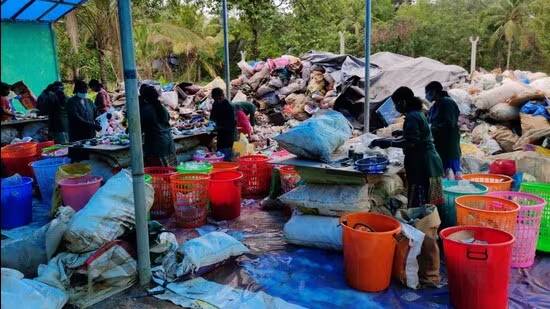
While waste pickers belong to the informal (plastic) sector, they are playing a major role in the circular economy of plastic. According to Lubna Anantakrushnan, member, SWaCH, Pune, the important contributions by the waste pickers in the city include: door-to-door waste collection, segregation of plastic material, and sending of the same to recycling centres.
The informal recycling sector is already recycling a substantial portion of the expected recycling under EPR. The recovery rate for rigid plastics in 2022 (69%) is far higher than the recycling target for 2024-25 (50%). However, for these recycling rates to be formally notified under the EPR framework, recyclers need to be appropriately registered, and this may prove to be a challenge for the large informal sector, Anantakrushnan said.
Scientists too contributing to plastic waste circular economy
Currently, there are limited options available for recycling plastic material including alternative fuels and reusing products among others. However, the industry is exploring other options too for recycling, for which it is seeking help from scientists.
One such research institute in Pune carrying out important research in the circular economy of plastic waste is the National Chemical Laboratory (NCL). The institute has successfully experimented with a few products including auto parts, and plant pots made using recycling nonwoven plastic material. H V Pol, scientist, NCL, said, “The mechanical recycling branch for plastic waste is working on developing various products from various types of plastics apart from PET. There are several types of research going on in this field that will boost the circular economy.”
Similarly, the chemical recycling branch analyses the chemical formulation of plastic materials. By decoding the material, scientists can figure out the possible recycling methods for plastics that are non-biodegradable, said Sameer Chikhli, scientist, NCL Pune.
#ruralindia #ruraltv #rural #nature #agricultura #farmlife #farming #india #rurallifestyle #ruralarchitecture #ruralhouse #ruraltourism #ruralexploration #ruralliving #rurallifestyle #ruralwomen #health
